LinkedIn vs Resume: Do You Still Need a Traditional CV?
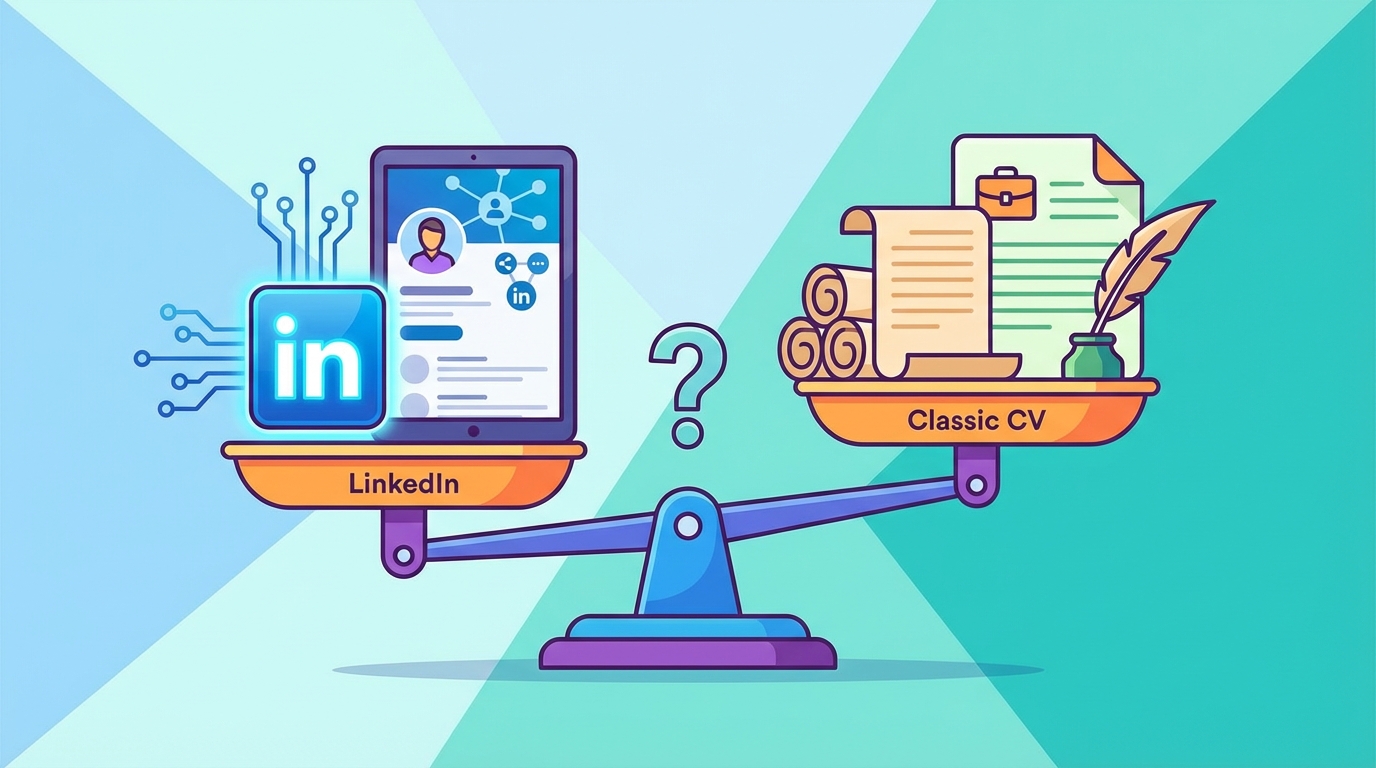
The Two-Document Paradox A hiring manager receives a LinkedIn message from what looks like a perfect candidate. The profile is polished — strong headline, relevant experience, solid recommendations. They ask for a CV.
The Two-Document Paradox
A hiring manager receives a LinkedIn message from what looks like a perfect candidate. The profile is polished — strong headline, relevant experience, solid recommendations. They ask for a CV. The candidate sends back what is essentially a copy-paste of their LinkedIn summary reformatted into a Word document. Same vague descriptions. Same generic language. No tailoring for the role.
Read also: Is LinkedIn Still a Professional Network in 2026?
The interview never happens.
You've been told to "optimize your LinkedIn" and "keep your CV updated" — but nobody explains why you need both or when each one actually matters. Most career advice treats them as interchangeable formats for the same content. They're not. They serve fundamentally different functions in the hiring process, and confusing those functions is one of the most common — and most invisible — mistakes professionals make.
This article breaks down which document wins in specific hiring scenarios, based on how recruiters and hiring managers actually make decisions. Not how we wish they would. Not how LinkedIn's marketing team suggests they should. How they actually do.
Recruiters Use LinkedIn to Hunt, CVs to Justify
LinkedIn is a discovery tool. Your CV is a decision-making document.
Read also: QR Code on Business Cards: The Competitive Advantage Every Professional Needs in 2026
Confusing the two costs you opportunities you never even know about.
Here's how the hiring process actually works in most organizations: recruiters search LinkedIn by keywords, job titles, and connections. This is the hunting phase. They're scanning dozens — sometimes hundreds — of profiles looking for potential fits. At this stage, your LinkedIn headline, your summary, and your most recent role title are doing almost all the heavy lifting. You either match the search or you don't.
But when that recruiter needs to present candidates to a hiring manager, they need something different entirely. They need a formatted document that can be printed, annotated, placed side-by-side with other candidates, and discussed in a meeting. They need a CV. LinkedIn profiles are optimized for algorithms and quick scanning. CVs are optimized for human judgment under time pressure. A hiring manager sitting in a room with several printed CVs on the table is making a fundamentally different kind of decision than a recruiter scrolling through LinkedIn search results.
Consider how a "Marketing Manager" position gets described in each format:
- LinkedIn version: First-person storytelling, conversational tone, personality-driven. "I help brands find their voice in crowded markets. Over the past several years, I've built campaigns that actually move the needle."
- CV version: Achievement-focused, third-person implied, scannable, quantified. "Led integrated marketing campaigns generating significant pipeline growth. Increased qualified leads substantially year-over-year through content strategy redesign."
Both are accurate. Both describe the same person. But they serve completely different audiences at completely different moments in the decision-making process.
The critical practical reality: if a recruiter can't quickly extract a clean, formatted CV from their applicant tracking system and send it to a hiring manager, you're out of the running. Your LinkedIn profile — no matter how brilliant — doesn't solve this problem.
The "LinkedIn-Only" Candidate Red Flag
When a candidate responds to a CV request with "just check my LinkedIn," experienced recruiters hear something specific. And it's not "I'm so modern and forward-thinking."
It reads as: "I haven't bothered to tailor anything for your specific role."
In corporate environments and traditional industries — finance, legal, engineering, government — a CV-less candidate is seen as unprepared or difficult to work with. These industries have formal hiring processes for a reason. Compliance requirements, standardized evaluation criteria, audit trails. A LinkedIn profile doesn't satisfy any of those needs.
There's also an accountability dimension most people overlook. LinkedIn profiles can be edited in real-time. You can change a job title, adjust dates, or rewrite a description after the fact with no record. A CV is a timestamped document. When you submit it, it becomes part of a formal record. Hiring managers know this, and it matters more than you'd think.
Now, this varies dramatically by context. A Berlin-based startup hiring a frontend developer may genuinely not care about a traditional CV. But even in "progressive" tech companies, final-round candidates are routinely asked for CVs because hiring committees need standardized formats to compare candidates fairly. The informal early stages give way to formal processes when real decisions — and real budgets — are on the line.
The exception: True executive headhunting, where a recruiter approaches you directly and the conversation moves through personal relationships. But that describes a small fraction of all job transitions.
Your LinkedIn Profile Can't Do These Three Things
There are specific hiring scenarios where LinkedIn structurally fails, regardless of how optimized your profile is. These aren't edge cases.
1. Targeted Positioning for Specific Roles
LinkedIn is a broadcast medium. You have one profile for all audiences. Every recruiter, every hiring manager, every connection sees the same thing.
A CV can be tailored. You can reorder sections, emphasize different experiences, and adjust language for each application. If you're applying for both a "Product Manager" role and a "Strategy Consultant" role, those require fundamentally different narratives about the same career history. LinkedIn forces you to pick one positioning. A CV lets you choose the right angle for each opportunity. This is not a minor difference. It's the difference between looking like a decent general candidate and looking like the specific person they need.
2. Formal Application Systems
Most large companies use Applicant Tracking Systems that require uploaded CVs. Yes, "Apply with LinkedIn" buttons exist. But they create auto-generated documents that are messy, poorly formatted, and immediately signal that you didn't put in the effort to submit a proper application.
Government jobs, academic positions, and regulated industries often legally require standardized CV formats. No LinkedIn profile — however comprehensive — satisfies these requirements.
3. Offline and Print Contexts
Interview panels print and annotate CVs during discussions. They write notes in margins. They circle things. They pass pages across tables. Career fairs, networking events, and conferences still rely on physical or PDF documents. And in markets where LinkedIn penetration is lower — parts of Central Europe, Asia, and the public sector globally — your profile may never be seen at all.
The bottom line: Your LinkedIn gets you noticed. Your CV gets you hired. They operate at different stages of the hiring funnel, and neither can replace the other.
When LinkedIn Actually Wins (And It's Not What You Think)
LinkedIn beats traditional CVs in exactly two scenarios — and most people use it wrong in both of them.
Scenario 1: Passive Candidate Discovery
You're not actively job hunting, but you want to be findable. This is where LinkedIn has no competition. Recruiters search the platform constantly for candidates who aren't applying to posted jobs. Your CV sits in a folder on your desktop. Your LinkedIn is a signal broadcasting around the clock.
The mistake most people make here is treating LinkedIn like a static resume — fill it out once, forget about it. A profile with no activity for an extended period tells recruiters you're either not engaged in your field or not interested in opportunities. Regular posts, thoughtful comments, updated projects — these are what make passive discovery actually work.
Scenario 2: Building Social Proof Before the CV
Hiring managers Google you after seeing your CV. Almost always.
Your LinkedIn provides context that no CV can: recommendations from real people, mutual connections, content you've shared, how you think about your industry publicly. It answers the questions a CV can't: "Is this person real? Are they credible? Do they actually think about their field, or do they just show up and collect a paycheck?"
The mistake here is having a LinkedIn that contradicts or undermines your CV. Different job titles, unexplained gaps, an outdated profile photo, zero activity. This doesn't add social proof — it raises doubts.
LinkedIn's biggest value isn't replacing your CV. It's making your CV more credible when someone receives it.
That reframe changes everything about how you should invest your time in each document.
The Hybrid Strategy That Actually Works
The question isn't "LinkedIn or CV?" It's "How do I make them work together as a system?"
LinkedIn = Your Professional Storefront
- Optimized for discovery: keywords in your headline, a compelling featured section, industry-relevant skills
- Shows personality and thought leadership through posts, articles, and engagement
- Demonstrates network and credibility through connections and recommendations
- Updated continuously, even — especially — when you're not job hunting
CV = Your Tailored Proposal
- Customized for each application with reordered sections and adjusted language
- Formatted for human decision-making: clean, scannable, printable
- Quantified achievements specific to the target role
- A timestamped document that creates professional accountability
How They Connect in Practice
- Recruiter discovers you on LinkedIn through keyword search, a mutual connection, or content you posted
- They review your profile for basic fit — industry, experience level, location, vibe
- They request your CV to evaluate you seriously against other candidates
- They Google you and check LinkedIn again for social proof and consistency
- Hiring manager receives your CV and may check LinkedIn for additional context before the interview
The common mistake is maintaining identical content in both places. This wastes LinkedIn's unique strengths — storytelling, social proof, real-time updates — and CV's unique strengths — tailored positioning, formal structure, side-by-side comparability. Here's what the difference looks like in practice:
- LinkedIn headline: "Helping B2B SaaS companies reduce churn through data-driven customer success strategies"
- CV headline for a specific role: "Customer Success Manager | Reduced Churn Significantly at [Company] | Expert in SaaS Retention"
Same person. Same expertise. Different framing for different contexts. The LinkedIn version attracts. The CV version convinces.
What to Do Monday Morning
If you're actively job hunting:
- Audit for consistency: Open your LinkedIn and CV side by side. Do the dates match? Do the job titles align? Does each format play to its own strengths, or are they awkward clones of each other?
- Create a master CV: Build a comprehensive version with every role, achievement, and skill. This is your source document. For each application, you'll cut and customize from this master — never start from scratch.
- Update LinkedIn for discovery: Add role-specific keywords to your headline. Populate your featured section with relevant work. Post one piece of content related to your target role. Make yourself findable.
If you're not job hunting but want to be ready:
- Set a quarterly reminder: Update both your LinkedIn and master CV with new projects, achievements, and skills. Doing this while memories are fresh takes minutes. Reconstructing months of work from memory takes hours.
- Build social proof now: One LinkedIn post per month in your area of expertise. It doesn't need to go viral. It needs to exist when someone checks your profile.
- Test your findability: Search LinkedIn for your target job title plus your key skills. Do you appear in the first few pages of results? If not, your profile needs keyword work.
You need both documents. The only question worth asking is whether you're using each one for what it actually does best — or whether you're forcing one to do the other's job, and losing opportunities in the gap between them.
Written by
Jiri Zmidloch
Founder of Carousel Gate and Process Gate AI. Expert in AI-powered content creation and LinkedIn marketing.
Ready to create stunning carousels?
Turn your ideas into professional LinkedIn carousels with AI. Choose a template, pick a style, and let AI do the rest.
Related Articles

Why Do People Share Personal Stories on LinkedIn?
Why are professionals increasingly sharing personal stories on LinkedIn instead of corporate updates? An analysis of the trend, data, and psychology behind the virality of intimate posts on the world's largest professional network.

5 LinkedIn Networking Tips That Grow Your Circle
I Analyzed 847 LinkedIn Connection Requests: Here's What Actually Works Picture this. A mid-level marketing manager spends two weeks crafting 50 personalized connection requests.
LinkedIn Carousel Tips: 10 Tactics to Triple Engagement
Struggling with low-engagement carousels? These 10 proven LinkedIn carousel tactics cover formatting, storytelling, design, and posting strategies that consistently triple engagement rates.